
(Individuals & Small Businesses, additional dates may apply depending on your situation)
Missing a tax deadline doesn’t just mean paperwork headaches, it can mean penalties, interest, delayed refunds, and cash-flow stress. And many taxpayers miss deadlines simply because they didn’t know they applied to them.
At Gerard CPAs, this is one of the most common issues we help clients avoid.
This post highlights the most important Federal tax dates in 2026, broken out for:
- Individual taxpayers, and
- Small business owners (including Schedule C filers, partnerships, and S corporations)
Bookmark this. Calendar it. Future-you will be glad you did.
Key 2026 Federal Tax Dates for Individual Taxpayers
(Applies to W-2 earners, retirees, investors, freelancers, sole proprietors / single-member LLC owners filing Form 1040 and others filing Form 1040)
January
- January 15 – Estimated Taxes are Due (IRS Estimated Taxes)
- Estimated tax payment due (covering September 1, 2025 through December 31, 2025 and earlier if other estimated tax payments were missed and/or underpaid)
- This applies to individuals such as:
- Self-employed individuals / Schedule C filers
- Investors with significant non-withheld income
- S-corp owners and partners who rely on estimates
- Estimated taxes are generally required if your withholding won’t cover most of your tax liability and you expect to owe at least $1,000 at filing. (IRS: Estimated Taxes)
- It does not apply to W-2 only taxpayers with sufficient withholding
- Paying by January 15 can help reduce underpayment penalties
- If you missed an estimated tax deadline anytime throughout the year:
- Pay as soon as possible. Note that penalties and interest accrue daily, and paying now limits the damage, even if it’s late
- Don’t skip the next payment. Missing one estimate does not excuse future ones, and multiple misses compound penalties
- You may still avoid penalties if withholding and estimates meet a “safe harbor” threshold or if income was uneven during the year (annualized income method). [Generally, safe harbor is met by paying at least 90% of the current-year tax or 100% to 110% of the prior-year tax, depending on income.]
- January 26
- January 31, however, February 2 this year (official date is January 31, but next business day if weekend/holiday)
- Deadline to receive:
- W-2s from employers
- Most 1099s (interest, dividends, non-employee compensation)
- If a W-2 or 1099 Is missing or incorrect: This is extremely common, and most delays are avoidable if handled early. The most common “Missing Form” scenarios include: a new job late in the year (e.g., W-2 mailed to old address); side income (1099-NEC issued but overlooked); investment accounts (corrected 1099 issued in February or March); gig work (income split across multiple platforms); and/or you did not meet the issuer’s reporting threshold which does not mean the income is non-taxable. Take these steps if a form is missing or incorrect:
- Step 1: Contact the payer first (fastest fix)
- Employer (for W-2s)
- Bank, brokerage, or platform (for 1099-INT, 1099-DIV, 1099-NEC, etc.)
- Many corrections are issued as a “Corrected” form and replace the original
- Step 2: Check with the IRS
- a. Contact the IRS
- b. The IRS often (eventually) has a copy even if you don’t (see Get your tax records and transcripts on the IRS website – IRS account login required) Especially helpful if:
- You changed jobs
- A company went out of business
- You used gig platforms
- Don’t file with bad numbers: Filing with missing or incorrect income is one of the fastest ways to:
- Delay refunds
- Trigger IRS notices
- Require amendments later
- Additional IRS Resources:
- Step 1: Contact the payer first (fastest fix)
- [business owners] Deadline to issue 1099s, W-2s and other related forms to contractors and/or employees (For many small business owners, the tax year starts in January, not February.)
- Form 1099-NEC to your contractors
- Applies if you paid $600 or more, and to non-employees (freelancers, consultants, service providers)
- Copies must also be filed with the IRS
- Common mistakes:
- Misclassifying employees as contractors
- Forgetting part-time or one-off service providers
- Missing corrected 1099s when amounts change
- W-2 if you have employees: W-2s must be issued to employees and filed with the Social Security Administration (which then shares the data with the IRS) This applies even if you only had one employee, the employee worked part-time, or payroll was run through a third-party services.
- These deadlines come before your personal tax return is due. Late or incorrect 1099s and W-2s can trigger:
- IRS penalties
- IRS notices
- Payroll audits
- Form 1099-NEC to your contractors
- Deadline to receive:
February–March: Get Organized Before Filing Season Peaks
This is the window where a little preparation saves the most time, stress, and money later.
Find a CPA (or lock in your CPA from last year)
If you plan to work with a CPA this year, or are considering a change, now is the time to act. Availability narrows quickly as filing season approaches, and by March many firms are no longer taking on new work. Request a consultation early to secure a spot. Contact Gerard CPAs to discuss your needs and receive a quote.

Examples of Tax-Related Information to Gather
- Identity Protection PIN if you received one from the IRS
- All tax forms received (W-2s, 1099s, K-1s)
- Brokerage statements
- Record of other sources of income (e.g., self-employment, gambling/prize winnings, unemployment benefits)
- Ensure you have information about your overtime and tips (new opportunities for tax breaks as a result of the One Big Beautiful Bill Act)
- Prior-year tax return(s)
- Records of:
- Charitable contributions
- Medical expenses
- Property taxes and mortgage interest
- Retirement contributions
- Investment information (e.g., stocks, rental property, home sales data)
- Education expenses
- Child/dependent care
- For small business owners:
- Income and expense summaries
- Mileage logs
- Payroll and contractor payments
- Energy credits
- Health insurance forms (e.g., Form 1095-A if you bought through the Marketplace, Form MA 1099-HC)
- Estimated tax payments already made
- NOTE: New changes as a result of the One Big Beautiful Bill Act
Just a few areas to review
- Did your income change materially from last year?
- Did you start, close, or change a business?
- Did you move, marry, divorce, retire, or sell investments?
- Are you subject to estimated taxes or penalties?
These answers affect how and when you file, not just what you owe.
Why Timing Matters: April deadlines are fixed, preparation windows are not
- Waiting until April limits options
- Early review allows time to:
- Fix missing or incorrect forms
- Make catch-up retirement contributions
- Plan for cash needed by April 15
- March is when filing volume spikes—and flexibility drops

Getting Information to Your CPA
Even though you may have engaged a CPA, timing still matters. Tax work can’t begin until your information is complete. Delays in providing documents:
- Compress review time
- Limit planning opportunities
- Make extensions more likely
- Increase potential for higher preparation costs
Early submission gives your CPA time to ask questions, resolve issues, and file accurately, instead of rushing under deadline pressure.
[March 16, 2026 – Tax returns are due for certain business entities, including partnerships and S corporations. (See “Key 2026 Federal Tax Dates for Small Business Owners” below)]
April
- April 1: RMD #1 Deadline
- Deadline (under current rules) to take your first RMD if you turned 73 in 2025. This applies to traditional IRAs, SEP IRAs, SIMPLE IRAs and most employer retirement plans. If you delay your first RMD until April 1, you will still need to take your second RMD by December 31, 2026, potentially having two distributions in one year. Why this matters:
- RMDs are taxable income
- Doubling up distributions may:
- Push you into a higher tax brackets
- Increase Medicare premiums
- Trigger additional taxes
- Timing your first RMD is a tax decision—not just a compliance one. NOTE: Missing an RMD can trigger a significant excise tax, though some relief may be available if corrected promptly under Internal Revenue Service rules.
- Deadline (under current rules) to take your first RMD if you turned 73 in 2025. This applies to traditional IRAs, SEP IRAs, SIMPLE IRAs and most employer retirement plans. If you delay your first RMD until April 1, you will still need to take your second RMD by December 31, 2026, potentially having two distributions in one year. Why this matters:
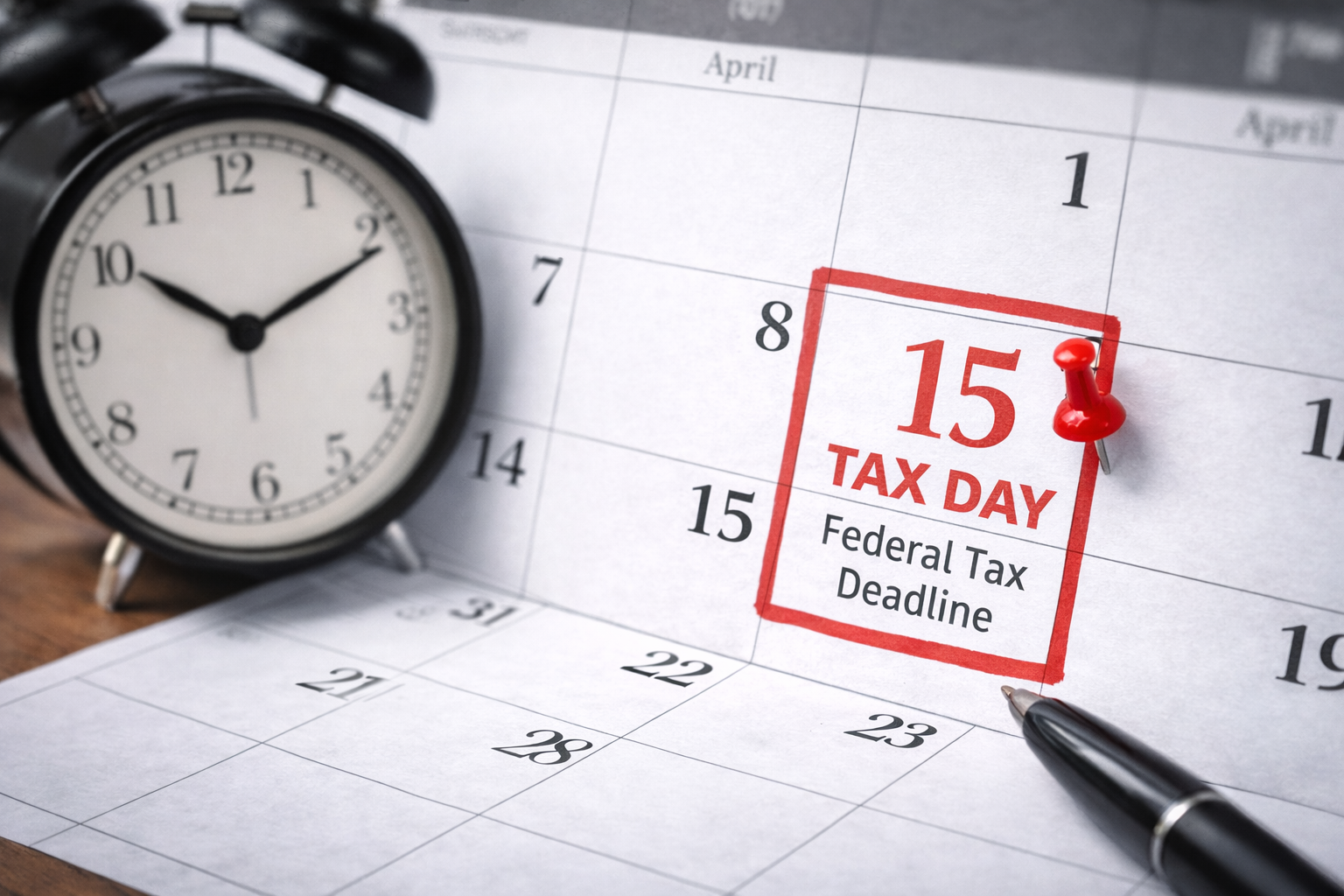
- April 15: The single most important tax deadline for individuals, regardless of business ownership.
- Individual Federal tax return due (many, but not all, state returns are due at the same time)
- First estimated tax payment for 2026 due (IRS Estimated Taxes)
- Extension requests due. Important: Always file or extend. An extension provides additional time to file your return, but not additional time to pay. Any tax owed is due by April 15, and interest accrues from the original due date, even if an extension is filed.
- Deadline to make IRA contributions for tax year 2025. This applies to traditional IRAs and Roth IRAs. NOTE: The contribution must be designated for 2025, not 2026. This matters because traditional IRA contributions may reduce taxable income for the prior tax year and Roth IRA contributions lock in tax-free growth.
- Deadline to make Health Savings Account contributions for the prior year.
- Tax Refund Status? Check the tax refund status of your federal and/or state tax return after you have e-filed or filed an accepted tax return. (IRS: Where’s My Refund?; MA-Your Personal Income Tax Refund; NY-Check your refund status online—anytime, anywhere!; CT-Where’s my refund? and other CT needs)
June
- June 15
- Second estimated tax payment due (IRS Estimated Taxes)
- Commonly missed by self-employed taxpayers and investors
September
- September 15
- Third estimated tax payment due (IRS Estimated Taxes)
- Last real checkpoint before year-end planning
October – November
- October 15
- Extended individual return due
- Miss this and penalties escalate quickly
- Meet with your CPA and financial planner to review year-end tax and financial planning opportunities
December (Not a Filing Deadline—But Still Critical)
- December 31
- Deadline for:
- Income timing decisions
- Retirement contributions (some types)
- Capital gains and investment planning
- Charitable giving
- Use-it-or-lose-it flexible spending accounts
- RMDs: If you’re subject to required minimum distributions (RMDs), the distribution must be taken no later than December 31 of the year. (see “April 1” above for first year exception and additional details)
- State and local tax planning
- Accelerated deductible expenses
- Many tax strategies cannot be fixed after year-end
- Deadline for:
Key 2026 Federal Tax Dates for Small Business Owners
This section applies even if you ultimately file a Form 1040.
Business Structures That Change Your Tax Issues
(Even If You File a 1040)
Sole Proprietor / Single-Member LLC (Schedule C)
- Files with your individual return
- Still subject to:
- Quarterly estimated taxes
- Business-specific deductions and rules
- Even though deadlines don’t change, work starts earlier:
- Income & expense records must be finalized sooner
- W-2s and 1099s must be done by January 31
- Basis, depreciation, mileage, and inventory need review
- Estimated tax accuracy matters more (no payroll withholding buffer)
- –> This additional information is why CPAs often push Schedule C clients to submit information earlier than W-2-only filers.
Partnership
- Separate Federal return
- Owners receive K-1s
- Deadlines matter because everyone else’s return depends on it
S Corporation
- Separate Federal return
- Requires payroll for owner-employees (work with your CPA for reasonable compensation determinations)
- K-1s flow to personal returns
Select Business Filing Deadlines
Partnerships & S Corporations
- February 2: Send out W-2, 1099 and other related forms (see “Deadline to issue 1099s, W-2s and other related forms for contractors and/or employees” above)
- March 16: Tax returns are due for certain business entities, including S corporations and partnerships.
- S Corporations
- File Form 1120-S for a calendar year.
- Furnish Schedule K-1 (and K-3, if applicable) to each shareholder.
- Although S corps generally do not pay Federal income tax, any entity-level tax, payroll tax, penalties, or interest must be paid by the due date.
- To obtain an automatic 6-month extension, file Form 7004 by March 16, 2026.
- An extension gives you more time to file, not more time to pay. Any tax owed must be paid by the original due date to avoid interest and penalties.
- File Form 2553 to elect S-corporation status beginning with the 2026 calendar year. (if applicable)
- Partnerships
- File Form 1065 for a calendar year.
- Furnish Schedule K-1 (and K-3, if applicable) to each partner.
- To obtain an automatic 6-month extension, file Form 7004 by March 16, 2026.
- While partnerships generally do not pay federal income tax, any applicable entity-level tax, penalties, or interest must still be paid by the original due date.
- Fiscal-Year Filers: If your business operates on a fiscal year, the return is due on the 15th day of the third month after the close of the tax year. Extension rules follow the same timing logic.
- S Corporations
- April 15, 2026 – Individual Federal income tax returns are due. (see earlier section)
- Even if your S corporation or partnership return was filed or extended in March, individual owners must still file Form 1040 (or request an extension) by April 15, 2026, and pay any personal income tax owed, including tax on pass-through income reported on Schedule K-1. [see “Key 2026 Federal Tax Dates for Individual Taxpayers” above]
- September 15
- Extended return due for S corporations and partnerships.
Estimated Tax Deadlines for Business Owners
(Applies to Schedule C filers, partners, and S-corp owners)
- April 15 – Q1 payment
- June 15 – Q2 payment
- September 15 – Q3 payment
- January 15, 2027 – Q4 payment
Missing these is one of the most common and expensive mistakes for small businesses.
If You Have Employees (or Pay Yourself via Payroll)
- Payroll tax deposits are ongoing (e.g., monthly or semi-weekly)
- Annual reporting deadlines matter
- Payroll mistakes trigger disproportionate IRS attention
- Consult your CPA to stay on track
Final Thoughts
With the right planning and actions, tax deadlines become checkpoints, not stress points. Knowing which dates apply to you is the first step to staying compliant, avoiding penalties, and reducing unnecessary stress.
At Gerard CPAs, we work with individuals, small business owners, and high-income filers to plan ahead, stay compliant, and make smarter tax decisions throughout the year—not just in April. Whether you’re preparing your 2025 return, navigating new tax rules, or evaluating whether your business structure still makes sense, we’re here to help.
Now booking for the 2025 tax season. Schedule a consultation today.
Disclaimer: The information contained in this post is a general summary of current federal tax provisions as of the date of publcation and may not reflect subsequent changes in law, regulations, or administrative guidance, including changes that may apply retroactively. This content is provided for informational purposes only and is not intended to constitute tax, financial, or legal advice. Reading or relying on this content does not create a CPA-client relationship. You should consult your own qualified tax advisor regarding your specific facts and circumstances.